You’ve probably come across various sources that claim teak is an evergreen tree and others saying it’s deciduous. Confusing, isn’t it? But for internet blogs and forums that say teak is evergreen, we say it is actually quite the opposite.
Teak is a deciduous tree. Not evergreen, nor coniferous. Its leaves fall off during the dry months and grow new foliage when the wet season comes.
And we bet that a lot of people don’t know why teak trees shed their leaves at certain periods of the year. In this post, we will look into how teak grows and behaves through seasons.
What Is Teak Tree?
The teak tree (Tectona grandis) is a tropical hardwood tree native to south and southeast Asia, mainly India (Sagaun), Myanmar (Burmese teak), Thailand (siamese teak), Indonesia in Java, and Malaysia. Some are also found in the Philippines, as well as Africa, Central America, and South America.
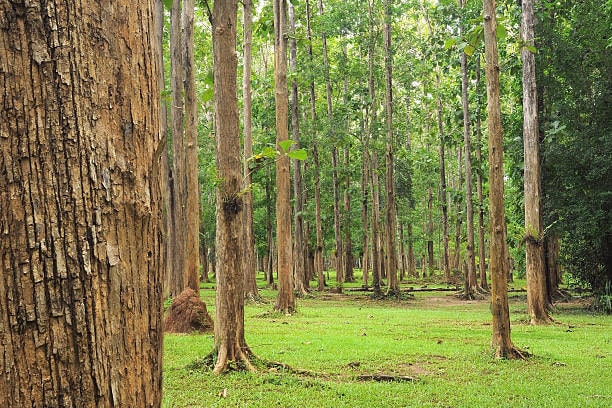
This tree is large and can grow up to 164 feet in mixed hardwood forests. It thrives under moist and warmer climates in areas with an annual marked dry season that lasts for 3 to 5 months and rainfall (wet season) with an altitude of 1,250mm to 2,500mm.
Teak trees simply don’t grow in evergreen rainforests. They also don’t grow near coastal areas, however, they do in low hills up to 3,000 feet.
Such trees need a resting season, which is the dry season. In this particular period, the teak trees shed their leaves and their fragrant white flowers to allow them to grow properly. Without the dry season, a teak tree will be forced to vegetate and lose water through its leaves. But that is when a teak tree becomes evergreen.
In the hot localities of its Asian origin countries, teak trees are leafless. Teak plantations in north Thailand for example, teak leaves will start to fall in January. However, in areas that are more moist, the teak tree remains green until the month of March.
After the dry season comes the monsoon weather. When the monsoon rains fall, there will be new foliage. This means the tree will grow new leaves. The cycle continues until the teak tree matures and is ready for harvest.
Other Facts About Teak
Teak is one of the best sought-after hardwoods for good reasons. Here are some little-known facts about this amazing tree:
It Belongs to The Verbenaceae Plant Family
Teak is a part of the Verbenaceae (or verbena) family. It’s a group of plants (trees, shrubs, and herbs) that grows in hot, tropical climates. Plants or trees in the Verbenaceae are usually flowering plants, in which many have a fragrant smell. The verbena plant family includes around 30 genera and some 1,100 species.
It’s Named After a Malayalam Word
The term “teak” is derived from the Malayalam word “tekka.” Malayalam is a Dravidian language that is widely spoken in India’s southern state of Kerala. The word reflects its historical and cultural importance in Kerala, India.
It Has Natural Oils That Keep Termites at Bay
It is not the hardest wood out there. But when it comes to durability, teak can beat most other types of wood—all thanks to its natural oils.
Teak trees contain high amounts of natural oils and rubber that keep termites and pests at bay. The protective oils shield the wood against moisture, making it practically waterproof. It repels water, so it won’t foster mold and mildew growth.
Due to its water-resistant properties, most ship decks and indoor and outdoor furniture pieces are made from teak wood. It can take a lot of weight without breaking or cracking, which makes it ideal for high-traffic areas. The rubber or the silica content in teak also makes it naturally anti-skid.
In addition, teak woods require little to no maintenance. Again, this is due to the ample amounts of natural oils that keep them protected from the elements. There is no need for sealing, staining, or varnishing. The steak in itself is beautiful.
With its deep, golden brown color and straight even grains, it has an inherent beauty that no other wood has. Yes, it can weather over time. But even that is nothing to worry about. When it ages, the color develops into a lovely silvery grey finish.
Frequently Asked Questions About Teak Tree
Is Teak Tree a Dry Deciduous or Evergreen?
Teak trees are considered deciduous trees. In Southeast Asia where most teak trees are sourced, it sheds leaves during the dry season. But when there’s no marked dry weather, teak trees will remain evergreen.
Why Is Teak Deciduous?
Similar to other trees in tropical monsoon forests, teak trees shed their leaves during the summer months. It’s a teak tree’s way to conserve water and energy during the drier seasons.
What Is the Lifespan of Teak Wood?
Teak trees can live in the natural teak forests for over 100 years. Furniture pieces made out of teak wood can survive up to 75 years with proper maintenance.
What Are the Characteristics of Teak Wood?
Besides toughness and its water-resistance properties, teak wood boasts an inherent beauty. It has a natural rich, golden brown color and is very low maintenance. This wood doesn’t need sealing, staining, or varnish. Due to the teak’s high oil content, it shines naturally. If you have outdoor teak furniture pieces, consider them a treasure.
Does Teak Last in Rain?
Even as a tree in the wild, teak can withstand extreme elements. Outdoor furniture pieces or anything made from teak that is used in high-moisture areas can survive constant water exposure because the wood is water resistant.
This is why you’ll see teak furniture indoors as window frames, shower floorings, and bath mats. Teak wood is extremely durable that it’s also used as a deck material in most ships.
What Are the Disadvantages of Teak Wood?
Teak is expensive. Mainly because the wood is hard to source. While teak is one of the fastest-growing trees (an inch per day), it takes up to 25 years for one mature tree to be ready for harvest. So, unlike other types of wood, it is not always readily available in the market. This makes the price go up, making it a premium hardwood.
Conclusion: Is Teak Evergreen?
Teak wood is not evergreen, nor is it a coniferous tree. It typically grows in warmer and moist areas where there is a marked dry season and monsoon weather, all year round. The teak tree sheds its leaves in the summer months as a response to the changing weather in the wild.
When the weather is dry, there is not enough water in the surroundings. A teak tree needs to keep itself from losing water through its leaves by shedding them. It is the tree’s way of conserving its energy. If the tree doesn’t shed its leaves, it will be forced to vegetate and this will affect its growth.
But, at the end of the dry season, it will start to grow new leaves. This amazing tree has to go through seasons in order to grow and survive.
We hope you’ve learned something today. If there are questions we haven’t answered in this post, let us know and we will be happy to help. Thanks for reading!